Author: Georgia Bekridaki, RIPESS Europe
On 7 January 2026, the European Citizens’ Initiative (ECI) Good Food For All campaign was officially launched, with RIPESS taking part as an active participant. The campaign is coordinated by Good Food for All (GFFA-EU), a Brussels-based civil society coalition working to ensure that food is recognised as a fundamental human right, adequate, safe, nutritious and produced in a sustainable way.
Over the coming year, RIPESS will work together with nearly 200 organisations across the European Union to collect at least one million signatures from EU citizens. Reaching this threshold will oblige the European Commission to respond and will strengthen our collective push for a real change in EU food policies, grounded in social justice, sustainability and democracy.
The campaign puts forward a clear set of demands that address the structural problems of today’s food systems — from access to food and farmers’ livelihoods to environmental protection and market power. These demands call on the EU to enshrine the right to food in its laws and policies, support peasants and agroecology, ensure fair prices and healthy diets, strengthen animal welfare, tackle land concentration and market monopolies, and ban speculation in agricultural commodities and foodstuffs.
More information about the campaign and its demands is available at: https://www.goodfoodforall.eu
Let’s go a step further and examine how the demands of the Right to Food campaign directly intersect with the EU–Mercosur agreement
- Enshrining the right to food in EU laws and policies
Across Europe, access to food is still treated primarily as a market outcome rather than as a fundamental human right. While the right to food is clearly recognised in international law and by the United Nations as the right of everyone to have regular, permanent access to adequate, safe, nutritious and culturally appropriate food, the European Union has never fully embedded this right into binding EU legislation or policy frameworks. As a result, food insecurity, diet-related diseases and rural poverty persist even in one of the wealthiest regions of the world. Recognising the right to food in EU laws would require EU institutions to assess how agricultural, trade, climate, competition and social policies affect people’s ability to access food with dignity. This approach aligns with existing EU commitments under the European Green Deal and the Farm to Fork Strategy, yet these strategies remain fragile as long as the right to food is not legally protected.This contradiction becomes particularly visible in the context of trade policy. The EU–Mercosur agreement prioritises export growth and market access while failing to include enforceable safeguards for the right to food. By promoting food systems that displace small-scale farmers, accelerate environmental destruction and undermine local food production, the agreement risks violating the very principles the EU claims to defend. A genuine commitment to the right to food cannot coexist with trade deals that structurally undermine food security and food sovereignty. - Supporting peasants and agroecology
Peasants, small-scale farmers and food producers are at the heart of Europe’s food systems. They play an important role in feeding communities, maintaining rural territories, protecting biodiversity and responding to the climate crisis. Agroecology offers a viable and proven alternative. Rooted in scientific knowledge, traditional practices and farmers’ expertise, agroecology strengthens local food systems, reduces dependence on chemical inputs and builds resilience to climate shocks. International bodies, including the FAO and the United Nations, recognise agroecology as essential for achieving sustainable food systems and for realising the rights of peasants as outlined in the UN Declaration on the Rights of Peasants.However, EU trade agreements move in the opposite direction. The EU–Mercosur deal reinforces industrial monocultures such as soy and beef production, driving deforestation, land grabbing and the displacement of rural communities in South America, while also increasing pressure on European farmers. By encouraging a model based on cheap exports and intensive production, the agreement undermines agroecological transitions on both continents. Supporting peasants and agroecology requires policy coherence, not trade incentives that reward environmental and social harm. - Ensuring fair prices and healthy diets
The current food system systematically fails both producers and consumers. Farmers across Europe are often paid below the cost of production, while consumers, especially those with low incomes, struggle to afford healthy, nutritious food. At the same time, ultra-processed and unhealthy products that occur the so called hidden hunger are widely available at low prices, while the true social, health and environmental costs of food are hidden. A rights-based food policy must address this imbalance. Fair prices for farmers, living incomes for food workers and affordable access to healthy diets are not separate goals are deeply interconnected. Ensuring fair prices means rethinking how value is distributed along the food chain and confronting the power of large retailers and processors. Ensuring healthy diets means reshaping food environments so that nutritious food is the easiest and most accessible choice.The EU–Mercosur agreement intensifies competition based on low prices and controversial quality standards, putting further pressure on European farmers while flooding markets with products produced under different social, environmental and health conditions. This dynamic fuels a race to the bottom that makes fair prices and healthy diets increasingly difficult to achieve. - Strengthening animal welfare
Animal welfare is not a marginal issue but a core component of sustainable and ethical food systems. The European Union formally recognises animals as sentient beings , and public concern for animal welfare is growing across Member States. Nevertheless, industrial livestock systems that prioritise productivity over animal well-being remain dominant, and EU standards are frequently undermined by imports.
Strengthening animal welfare requires more than incremental improvements. It calls for a transformation away from intensive livestock systems towards models that respect animal health, environmental limits and public health. This is closely linked to climate action, biodiversity protection and the One Health approach that recognises the interdependence of human, animal and ecosystem health.
The EU–Mercosur agreement undermines these goals by expanding imports of animal products produced under lower welfare standards. By allowing such products onto the EU market, the EU weakens its own animal welfare commitments and sends a clear signal that price and volume matter more than ethical standards. A food system that respects animals cannot be built on trade rules that reward harmful practices. - Tackling land concentration and market monopolies
Across Europe and globally, land and food systems are becoming increasingly concentrated in the hands of a few powerful actors. Large agribusinesses, financial investors and multinational corporations control growing shares of farmland, processing facilities and retail markets. This concentration erodes rural livelihoods, undermines democratic control over food systems and limits farmers’ autonomy. Land is not just an economic asset; it is the basis of food production, cultural heritage and community life. Tackling land concentration requires strong public policies that protect access to land for small-scale farmers, young farmers and new entrants, while regulating speculative investment and excessive market power.The EU–Mercosur agreement strengthens corporate control over global value chains and encourages land grabbing for export-oriented production. By reinforcing the power of multinational traders and processors, the agreement deepens inequalities and weakens food sovereignty in both regions. Democratic food systems cannot thrive under monopolistic market structures. - Banning speculation in agricultural commodities and foodstuffs
Speculation on agricultural commodities contributes to price volatility, destabilises markets and disconnects food prices from real supply and demand. These fluctuations hit farmers and low-income consumers hardest, increasing food insecurity and social instability.
Numerous international institutions and experts have warned about the harmful effects of excessive financial speculation on food markets. While the EU has taken some regulatory steps, loopholes remain, and speculative activities continue to influence food prices across global markets. By expanding global commodity flows, the EU–Mercosur agreement further exposes food systems to financial speculation and market shocks. Rather than reducing volatility, such agreements deepen dependence on global commodity markets, undermining the stability required to realise the right to food. Treating food as a human right means removing it from speculative logics and ensuring that food systems serve people, not financial interests.As the Right to Food campaign calls for food to be recognized as a fundamental human right across Europe, it also raises a crucial question: how coherent are EU policies with this commitment in practice?Nowhere is this contradiction more visible than in the EU’s trade agenda. The ongoing debate around the EU–Mercosur agreement shows that food policy, trade policy and democratic accountability are deeply interconnected. Peasant movements are not only challenging the social, environmental and food system impacts of this agreement, but also the way it is being pushed through EU institutions, revealing how the right to food is undermined both by policy content and by democratic process.
European Coordination Via Campesina (ECVC) and CLOC Celebrate European Parliament Vote on EU–Mercosur FTA
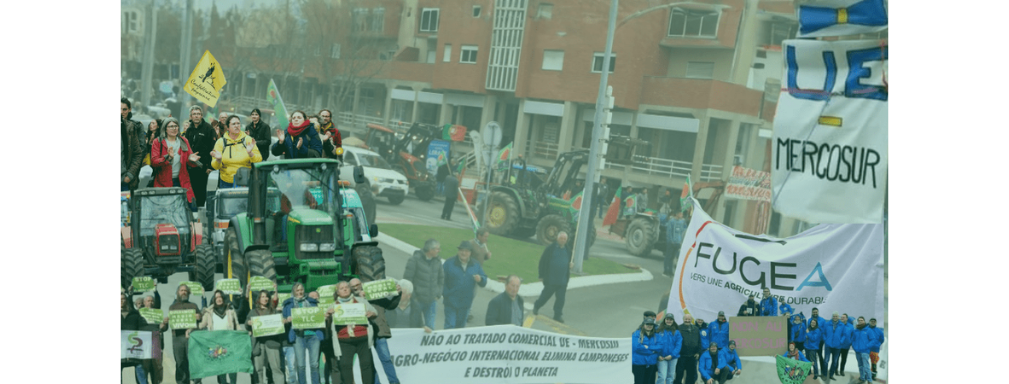
Peasant movements across Europe and Latin America welcomed the European Parliament vote on 21 January that referred the EU–Mercosur free trade agreement to the European Court of Justice for a legal opinion, seeing this as a significant check on how trade deals are being pushed through. According to Via Campesina and its member bodies, the decision demonstrated resistance to a process they view as undemocratic and procedurally flawed because the agreement has been artificially split into separate parts — allowing MEPs to vote on non-trade portions while the core commercial chapter bypasses full parliamentary and national scrutiny. This, they argue, undermines the democratic functioning of the EU and risks provisional application of the deal without proper approval.
Beyond procedure, Via Campesina stresses that the content of the EU–Mercosur agreement itself is deeply problematic. They contend the deal primarily serves corporate agribusiness and export-oriented interests, threatening peasant agriculture, rural livelihoods, food sovereignty and social and environmental rights on both sides of the Atlantic. For them, the democratic concerns cannot be separated from the substance of the trade pact — the way it is structured and promoted reflects a broader pattern of prioritizing market access over people’s rights.