Author: Jason Nardi, RIPESS Europe, based on an article by Lorenzo Tecleme on Diario Red
An occupied factory is writing the future of the ecological transition
For four years, a group of Italian workers has occupied a factory, demanding an ecological conversion and the relaunch of production. Now they are trying to actually achieve this through an unprecedented crowdfunding campaign and are asking for international support.
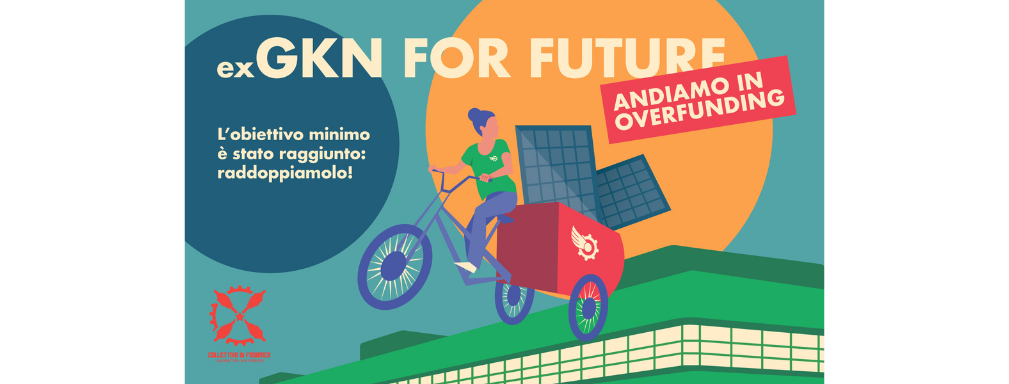
We already wrote about the former GKN Factory in Campi Bisenzio, a few kilometers from Florence, Italy, where the largest Mediterranean plant of the British metalworking multinational Gkn stood, producing components for the automobile industry. That was at least until 2021, when the company suddenly offshored production, dismissing the more than 400 workers employed at the plant. From this event – tragic but not uncommon in Italy, a country mired in deindustrialization for decades – there arose the longest worker occupation in the country’s history and one of the most notable grassroots ecological transition cases in Europe. The workers, who still occupy the factory and have received support from globally prominent figures such as Swedish activist Greta Thunberg, now have a new objective: to raise two million euros in order to start producing photovoltaic panels and cargo bikes.
The history of the former Gkn, from the beginning
The Gkn plant, a multinational in turn controlled by the investment fund Melrose, produced drive shafts for cars and was integrated into the supply chain of the car manufacturer Fiat. The Italian automotive sector has been in crisis for years and in 2021, still in the midst of the Covid emergency, the Campi Bisenzio factory was also hit. In June of that year, the owners announced the closure of the plant. The Italian media covered the events extensively, both because this was one of the first mass layoffs after the legal ban imposed during the worst moments of the pandemic, and because the workers learned that they no longer had a job via an email.
Inside the factory there was an active collective of workers that proved decisive: backed by the trust of their colleagues, the workers’ representatives managed the conflict in an absolutely unique way. The factory was occupied to prevent the owners from removing the machinery or repurposing the site for other uses, and from the outset the demand was for a genuine relaunch. The workers called for nationalization of the plant, self-management by the workers themselves, and an ecological conversion of production. The first relaunch plan, drawn up together with experts from the Sant’Anna School of Advanced Studies in Pisa, proposed the creation of a supply chain for green mobility focused on producing electric buses. At the same time, the workers sought and found collaboration with environmental movements, particularly Fridays For Future Italy. The workers’ collective of the former Gkn created a cooperative – GFF (Gkn For Future) – and became a point of reference for social movements across Italy, and in Florence it brought tens of thousands of people into the streets on more than one occasion.
Yet the plan did not succeed due to the substantial opposition of the authorities. But the workers were not discouraged and drew up a second proposal centered on assembling cargo bikes and photovoltaic panels – prototypes of which have also been produced. To make the relaunch possible, the Region of Tuscany passed an ad hoc law, thanks to the pressure from the community supporting the workers, and fundraising began with record figures. To date, one and a half million euros have been raised through popular shareholding, and another two and a half million through Banca Etica, a small ethically oriented cooperative bank. Now, however, the former Gkn collective is launching a new proposal: another two million are needed, and for this and a crowdfunding campaign has been opened.
Rearmament, climate crisis, deindustrialization, genocide: distinct but connected enemies
The former Gkn experiment is already remarkable in itself: a factory that responds to closure with a four-year occupation and a demand for workers’ control over production. But the value of this experience goes even further. From the outset, the group of occupiers framed their struggle within the broader fight for climate justice and ecological transition. The idea has always been to save jobs through the production of sustainable goods – electric buses, photovoltaic panels, bicycles – and to abandon unsustainable production such as that linked to combustion‑engine cars. To these themes two issues of enormous current relevance have been added: the genocide in Gaza and European rearmament.
The workers have been among the promoters of major Italian general strikes against the Israeli genocide of Palestinians, and the leaders of the former Gkn have from the beginning rejected any relaunch plan that would involve entering the arms business. Hence also the support of internationally known figures such as climate activist Greta Thunberg and of intellectuals famous in Italy such as the historian Alessandro Barbero.
Despite the millions already raised and the international attention, the struggle of the workers of of the former Gkn is far from won. The risk of eviction by the police is always just around the corner, and for the past eight months the workers have not been receiving either wages or unemployment benefits. That is why the success of the fundraising campaign is a matter of life or death for those who have been part of this struggle for the last four years. Anyone who wishes to donate can do so at this link.
Read the international appeal from the GFF workers collective and support the crowdfunding: https://insorgiamo.org/crowdfunding-2025
Telegram international community supporting GFF: https://t.me/+FprE0BT6OhI4NDYy
For International newsletter subscription press here